

Computer Software Assurance: 5 Easy Steps to Move From CSV
What Is Computer Software Assurance?
Computer software assurance is changing how GMP teams validate software. For years, Computer System Validation (CSV) has been the standard way to prove that GxP software works as intended. Computer Software Assurance (CSA) keeps the same goal. It simply focuses effort where the risk to patient safety, product quality and data integrity is highest.
In this blog, you will learn:
- What CSV and CSA mean
- Why computer software assurance matters now
- How risk-based testing works, with examples
- 5 steps to move from CSV to computer software assurance
CSV and Computer Software Assurance
Computer system validation (CSV), also called computerized or computerised system validation, proves that a GxP system is fit for its intended use. It applies across the full life cycle of systems such as LIMS, CDS, MES, ERP, SCADA and GMP spreadsheets.
GMP computer system validation requirements come from three main references:
- 21 CFR Part 11: electronic records, electronic signatures and audit trails
- EU GMP Annex 11: computerised systems, risk management and data integrity
- ISPE GAMP 5: the GAMP 5 risk-based approach to GxP software
A typical CSV package covers the core CSV documentation requirements:
- URS, functional and design specifications
- Risk assessment and validation plan
- Test scripts for IQ, OQ and PQ
- Traceability matrix and validation summary report
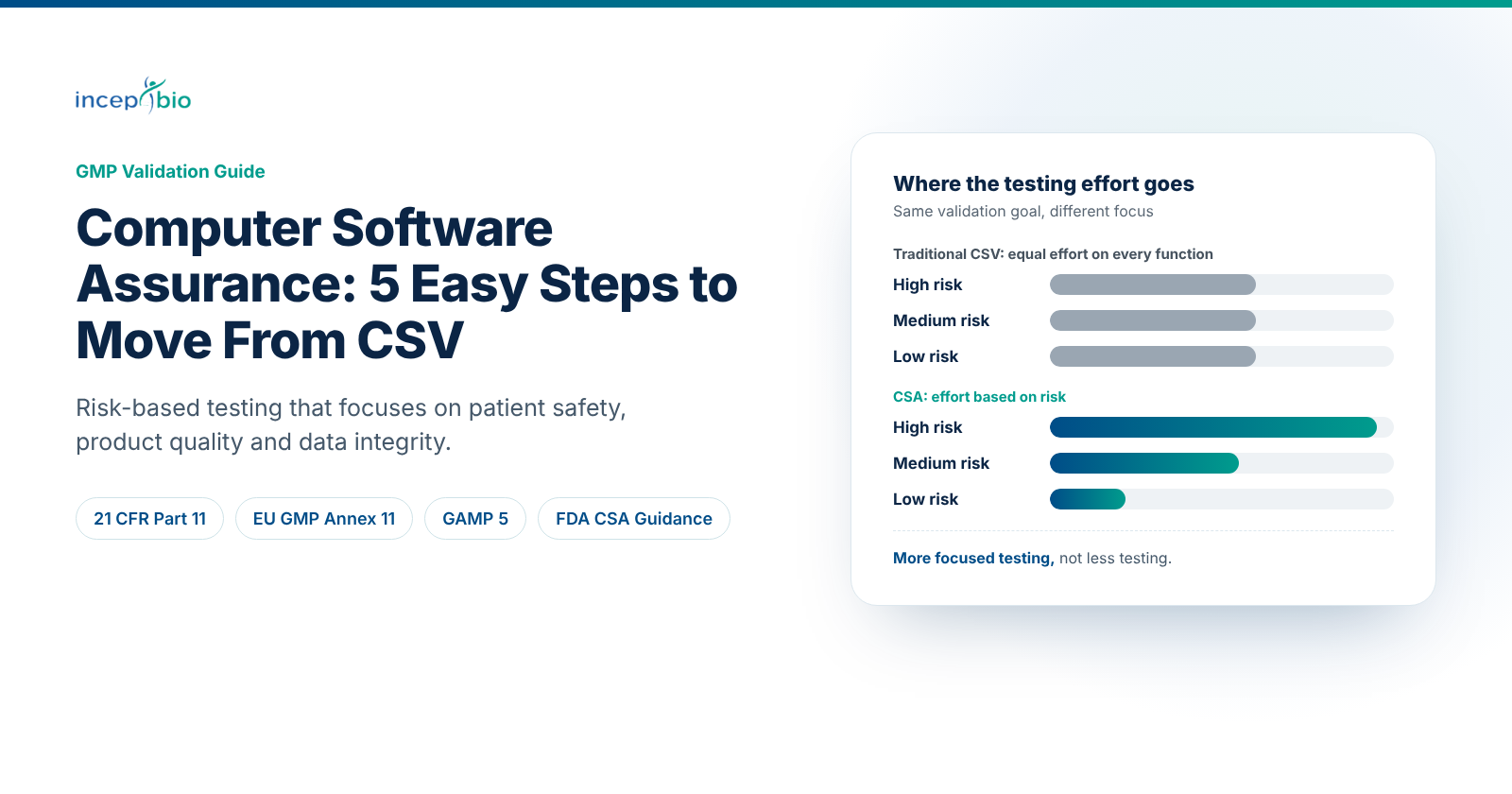
Computer software assurance (CSA) does not replace these. It puts critical thinking before documentation. Instead of asking “Have we documented everything?”, it asks “Have we tested what matters?” CSV spreads effort evenly. CSA puts more effort on critical functions and less on low-risk ones. CSA means more focused testing, not less testing.
Why Computer Software Assurance Matters Now
Two developments have made computer software assurance a practical decision:
- FDA CSA guidance: the FDA Computer Software Assurance guidance was finalised in September 2025 and updated in February 2026. It was written for medical devices, but its principles are now widely applied to computer software assurance in pharma.
- Data integrity inspections: in India, Revised Schedule M applies to every drug manufacturer. Inspectors now check audit trails, user access and electronic records directly in the system.
At the same time, many CSV programmes have become document-heavy:
- The same scripted tests are run on every function
- Supplier testing is repeated at site
- Real data integrity gaps are still missed
A risk-based approach is designed to fix exactly this.
Computer Software Assurance in Practice: Risk-Based Testing
Risk-based computer system validation starts with a computer system validation risk assessment. First, confirm the intended use. Production and quality system software is in scope. General business software, such as email or accounting, is not.
A function is usually high risk when it:
- Decides batch release
- Maintains critical process parameters
- Judges product acceptability without human review
- Applies electronic signatures to GMP records
Functions such as CAPA routing or complaint tracking are often not high risk. Computer software assurance testing then follows the risk level:
- High risk: robust scripted testing, fully documented and traceable
- Medium risk: limited scripted testing, plus unscripted checks
- Low risk: unscripted testing, such as exploratory or ad hoc tests
Reliable supplier testing can be used instead of repeating it at site. The final record stays lean: intended use, risk level, what was tested, issues found, conclusion, date and tester.
Some computer software assurance examples:
- LIMS validation in pharma: result calculations and approvals are tested in depth
- MES and ERP system validation: batch record steps and release decisions get scripted tests
- SCADA system validation: alarm handling and critical process data come first
- Spreadsheet validation: GMP formulas are verified and locked
A risk-based review also shows the gaps that matter. In a typical CDS review, common high-risk findings are audit trails not reviewed before batch release and shared analyst logins.
5 Easy Steps to Move From CSV to Computer Software Assurance
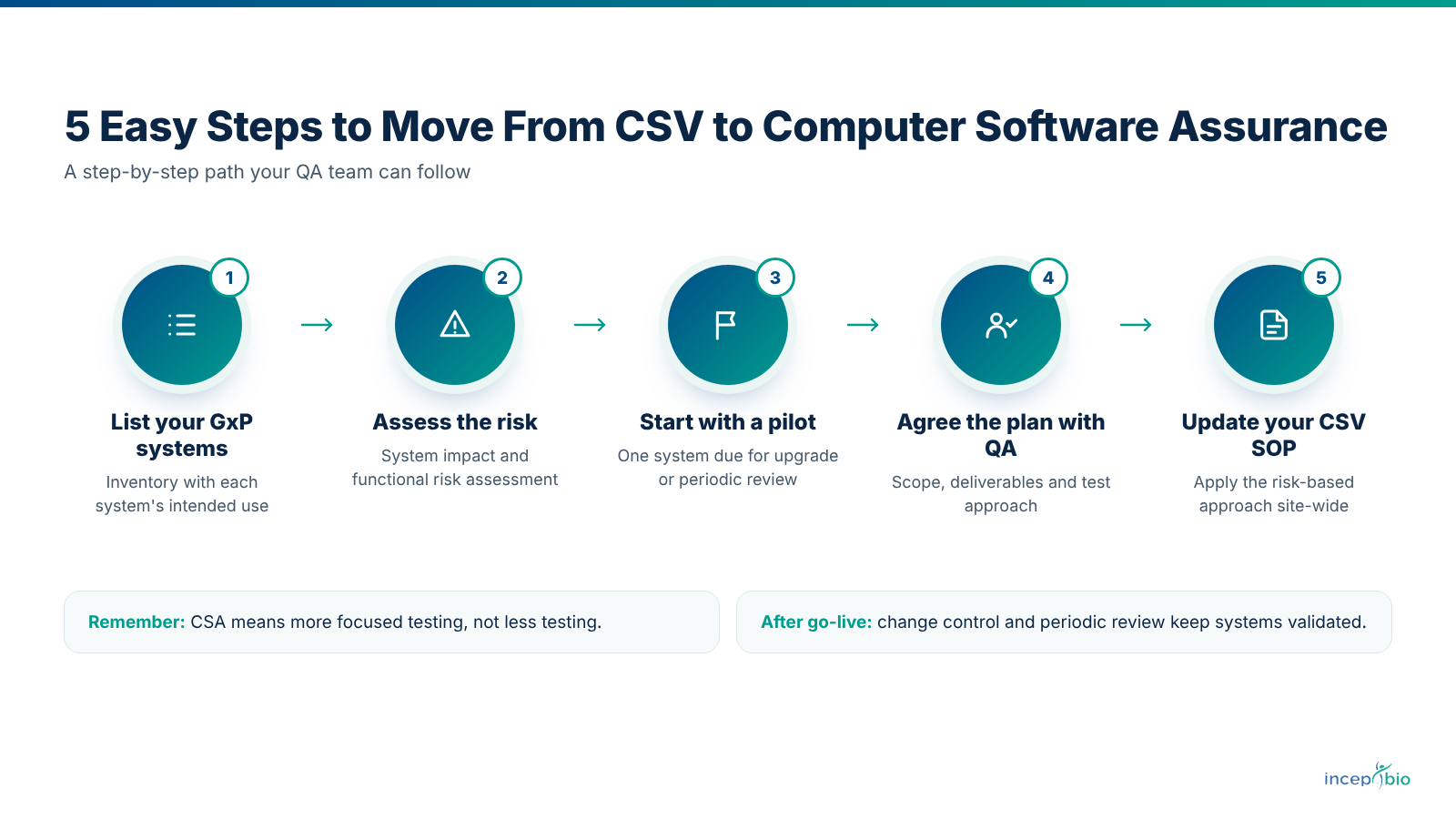
You can update your computer system validation process step by step:
- List your GxP systems: build an inventory with each system’s intended use
- Assess the risk: run a system impact and functional risk assessment
- Start with a pilot: pick one system due for an upgrade or periodic review
- Agree the plan with QA: confirm scope, deliverables and test approach
- Update your CSV SOP: apply the risk-based approach site-wide
The biggest challenge is cultural, not technical. QA and IT teams need training to think in terms of risk. CSV structure still stays where a system truly needs it.
Computer System Validation Services From IncepBio
IncepBio is a computer system validation company in India. We provide computer system validation services for pharma, biotech and life sciences. Our GAMP 5-trained consultants support both GxP computer system validation and risk-based CSA.
- CSV gap assessment: 21 CFR Part 11 compliance and Annex 11 review with a remediation plan
- New system validation: URS to summary report, including the traceability matrix
- CSV to CSA transition services: pilot system, risk classification and SOP update
- Change control and periodic review: systems stay validated after go-live
Our CSV validation services for pharma are delivered on site. Our team stays until the project is complete:
- GMP CSV services in Bangalore and GMP CSV services in Hyderabad
- Computer system validation services in India, with experienced CSV consultants in India
- CSV and CSA services in Malaysia and Singapore
CSV also works alongside our CQV services for new facilities. Explore our computer system validation consulting for your GxP systems.
Frequently Asked Questions
Will inspectors accept a CSA approach?
Yes, if every risk decision is justified and documented. CSA changes how you test, not what 21 CFR Part 11, EU Annex 11 and GAMP 5 require.
Do we need to revalidate our existing systems to adopt CSA?
No. Existing validated systems stay valid. Apply the risk-based approach at the next upgrade, change or periodic review.
Does IncepBio provide CSV and CSA services on site?
Yes. Our GAMP 5-trained consultants provide on-site computer system validation services in Bangalore, Hyderabad and across India, as well as in Malaysia and Singapore.
Which system should we start with?
Start with one system that is due for an upgrade or periodic review, such as LIMS or CDS. This gives your team a pilot before you apply CSA site-wide.