

Cleanroom Smoke Study: 6 Expert AFPT Services

Table of Contents
- Introduction
- What Is a Cleanroom Smoke Study (AVS)?
- Why a Cleanroom Smoke Study Matters
- Trending Topics in Airflow Pattern Testing
- Static vs Dynamic Cleanroom Smoke Study
- How to Prepare for a Smoke Study
- Typical Test Locations
- Acceptance Criteria
- Troubleshooting Common Failures
- Documentation Checklist
- Common Mistakes to Avoid
- Regulatory Expectations
- IncepBio Smoke Study & AFPT Services
- FAQ
- Conclusion
Introduction
- A cleanroom smoke study makes invisible airflow visible. In a sterile cleanroom, air movement cannot be seen with the naked eye. You cannot tell just by looking whether it is moving the way your design says it should.
- A single blocked HEPA diffuser can quietly break airflow protection. So can a badly placed equipment cart, or an operator reaching across a critical zone. None of it shows up on a particle counter until it is too late.
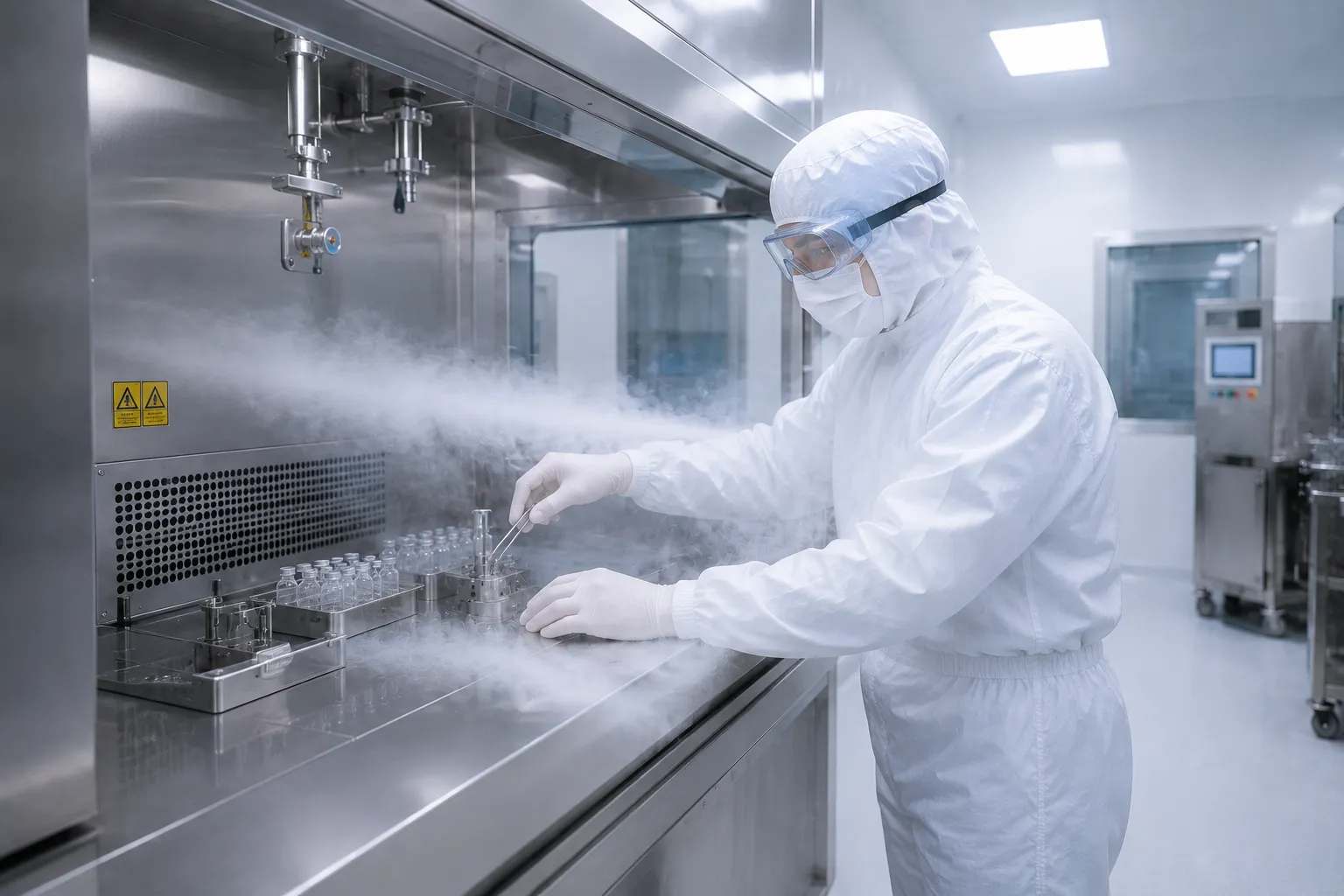
- This is where a cleanroom smoke study earns its place in every serious validation program. Also called an Airflow Visualization Study (AVS) or Airflow Pattern Test (AFPT), it uses a visible tracer such as smoke or suitable fog to make airflow patterns visible. Engineering, validation, and quality teams can then observe exactly how air moves through critical areas — catching disturbances before they reach an audit finding.
A properly planned cleanroom smoke study gives visual evidence of:
- Airflow direction and consistency
- Turbulence, eddies, and dead zones
- Airflow reversal
- The effect of personnel or equipment on critical airflow
Quick Answer: A cleanroom smoke study (AFPT / Airflow Visualization Study) is a GMP test that uses visible smoke to check whether cleanroom airflow moves as designed. Static testing checks airflow at rest; dynamic testing checks it during real operations. Both are required under EU GMP Annex 1 (2022) for Grade A/B areas.
What Is a Cleanroom Smoke Study (AVS)?
A cleanroom smoke study, or Airflow Visualization Study (AVS), is a controlled test. It visually assesses airflow behaviour inside a cleanroom, isolator, RABS, UDAF system, or other controlled environment. A suitable visible tracer is introduced into the airflow. Its movement is recorded. The results are then reviewed against the approved protocol and predefined acceptance criteria.
A properly designed cleanroom smoke study generally considers:
- Visual Evidence — observed airflow behaviour within the defined test area
- Tracer Fog — a visible, non-contaminating smoke or fog source
- Defined Test Conditions — static and/or dynamic, per the approved protocol
- Video Documentation — recorded for evaluation, reporting, qualification, and training
- Risk-Based Assessment — test locations chosen from facility design and contamination-control risk
Why a Cleanroom Smoke Study Matters
- Identify Hidden Airflow Risks
- Turbulence around equipment, critical areas, or obstructions
- Eddy currents where air circulates differently than intended
- Stagnant areas with limited or poor airflow movement
- Unexpected airflow paths not anticipated during facility design
2. Detect Airflow Reversal
- Demonstrates unexpected changes in airflow direction
- Helps assess whether air from a less-clean area could move toward a critical zone
- Provides visual evidence for further investigation
- Confirms whether unidirectional airflow (UDAF) is maintained around critical operations
- Assesses airflow around exposed product, components, and critical surfaces
- Checks whether personnel movement, equipment positioning, or interventions disturb protection
- Generates visual records, observations, screenshots, and reports for the validation package
- Required under EU GMP Annex 1 (2022) for Grade A/B areas to demonstrate unidirectional airflow and a state of contamination control
- Findings feed into decisions on environmental monitoring locations, personnel practices, and equipment placement
- Connects the cleanroom smoke study to the site’s broader contamination-control lifecycle, not a one-off video
Static vs Dynamic Cleanroom Smoke Study
Static Smoke Study — At-Rest Conditions
- Establishes the baseline / as-designed airflow pattern
- Performed with personnel and process activity absent
- Reveals: basic airflow irregularities, turbulence at rest, airflow reversal, dead zones, unexpected paths, UDAF behaviour
Dynamic Smoke Study — In-Operation Conditions
- Evaluates airflow while personnel perform real activities — material transfer, interventions, equipment operation
- Reveals: personnel movement effects, equipment interference, intervention effects, critical-area protection under load, recovery behaviour after a disturbance
Static vs Dynamic Cleanroom Smoke Study: At a Glance
How to prepare for a smoke study
Five things to lock down before smoke goes into the room.
HVAC readiness
Run HVAC under the conditions defined in the approved protocol.
Cleanroom condition
Clean and prepare the facility to match the study conditions.
Operator briefing
Walk personnel through movements, interventions, and test sequence in advance.
Camera planning
Position cameras in advance to cover critical areas and avoid blind spots.
Approved protocol
Objectives, locations, static/dynamic conditions, smoke source, acceptance criteria, and documentation requirements, signed off before testing starts.
Typical smoke study / AFPT test locations
Where testing is usually performed, chosen by facility design and risk.
Acceptance criteria for a smoke study
What the airflow needs to demonstrate to pass.
Unidirectional airflow
Expected direction and behaviour without unacceptable turbulence or reversal.
Absence of significant dead zones
No persistent stagnant regions where airflow is required.
Airflow direction
Air moves according to the intended design and pressure relationships.
Protection of critical areas
No unacceptable disruption from personnel, equipment, or interventions.
Recovery behaviour
Where included, recovery from disturbance should meet predefined criteria.
Troubleshooting common smoke study failures
Where to look first when a result comes back unexpected.
Eddies over critical areas
Often caused by equipment placement, obstructions, or distribution issues.
Airflow reversal near doors
Review room pressurization, HVAC balancing, door operation, and adjacent airflow relationships.
First-air disruption
Review operator technique, equipment positioning, and intervention procedures.
Corrective action
Investigate through deviation, CAPA, engineering, or change-control processes — address root cause, not just the symptom.
What you get: documentation checklist
Everything that should land in the final report.
Approved study protocol
Baseline data (cleanroom classification, HVAC/airflow conditions)
Smoke source details
Environmental conditions (temperature, humidity, pressure differentials)
Raw and edited test videos
Annotated screenshots of key frames
Step-by-step observation log
Results summary against predefined acceptance criteria
Deviation / CAPA notes where applicable
Conclusion linked to the qualification or CCS strategy
Common smoke study mistakes to avoid
Small gaps that quietly weaken an otherwise good study.
Poor video quality from low resolution or badly placed cameras
Testing too few locations or operating scenarios
Untrained personnel causing inconsistent dynamic-test movements
Incomplete documentation — missing screenshots, videos, or protocol references
Ignoring facility, HVAC, or process changes without reassessing airflow
Smoke studies and regulatory expectations
Exact requirements depend on the facility, product, process, cleanroom classification, and jurisdiction. Common reference points include:
ISO 14644-3
Cleanroom test methods.
EU GMP Annex 1 (2022)
Manufacture of sterile medicinal products; explicitly requires airflow visualization for Grade A/B areas.
PIC/S guidance
Applicable qualification and validation guidance.
WHO GMP requirements
Global qualification and validation expectations.
US FDA expectations
Aseptic processing guidance.
Site-specific requirements
Facility-level GMP and contamination-control requirements.
IncepBio Smoke Study & AFPT Services
IncepBio’s cleanroom smoke study service runs six connected study types to cover the complete airflow picture:
- Static Smoke Study — baseline airflow, HEPA visualization, return-air assessment, dead zone identification
- Dynamic Smoke Study — personnel movement impact, equipment interaction, airflow recovery evaluation
- UDAF, RABS & Isolator Studies — first-air verification, airflow sweeping assessment, intervention studies for Grade A zones
- HVAC Airflow Assessment — supply/return airflow mapping, distribution analysis, short-circuit identification
- Material & Personnel Movement Studies — airlock studies, pass-box assessment, door-opening impact
- Airflow Investigation & CAPA Support — dead-zone and reversal investigation, root-cause diagnostics, corrective action recommendations
Why pharma teams choose IncepBio:
Ultra HD 4K, multi-angle recording
No critical zone missed.
24-hour report delivery
Validation timelines don’t wait.
GMP-aligned smoke generation
Pharma-grade, DI water / WFI based.
Cleanroom fluid-dynamics specialists
Executed by qualified experts, not generalists.
Aligned to global standards
ISO 14644-3, EU GMP Annex 1 (2022), WHO TRS 1010, PIC/S PE 009, USFDA guidance.
Pan-India, Singapore & Malaysia
Coverage across all three regions.
Conclusion
A cleanroom smoke study is not just smoke and a video recording. It is the clearest way to prove that a cleanroom’s airflow actually behaves the way it was designed to. Static testing gives the baseline. Dynamic testing proves that baseline survives real people, real equipment, and real interventions. Together, they turn an invisible risk into visible, documented evidence — exactly what regulators, auditors, and quality teams need to see.
Key takeaways:
- Static cleanroom smoke studies establish baseline airflow at rest; dynamic studies test it under real operating activity
- Cleanroom smoke study data feeds directly into GMP qualification and the site’s Contamination Control Strategy
- EU GMP Annex 1 (2022) makes airflow visualization a requirement, not an option, for Grade A/B areas
- Good documentation — video, annotated screenshots, a clear report — is what makes results audit-ready
Frequently Asked Questions
What's the difference between static and dynamic smoke studies?
In a cleanroom smoke study, static runs with no movement, showing baseline airflow. Dynamic simulates real operations to check how personnel and equipment movement affect airflow.
Is a smoke study required under EU GMP Annex 1 (2022)?
Yes — it explicitly requires airflow visualization studies for Grade A and B areas to demonstrate unidirectional airflow and a state of contamination control.
Are smoke studies required for RABS and isolators?
Yes — they demonstrate first-air protection, airflow performance, and contamination control in Grade A environments.
What makes IncepBio different from other smoke study providers?
IncepBio uses Ultra HD 4K multi-angle recording, GMP-aligned pharma-grade smoke generation (DI water/WFI based), and delivers audit-ready reports within 24 hours — executed by cleanroom fluid-dynamics specialists, not generalist technicians.
Is IncepBio's smoke study service GMP and regulatory aligned?
Yes. IncepBio’s methodology aligns with ISO 14644-3, EU GMP Annex 1 (2022), WHO TRS 1010, PIC/S PE 009, and USFDA aseptic processing guidance.
How can I contact IncepBio for a smoke study?
You can book a free consultation directly on IncepBio’s smoke study page, or reach the team by phone at +91 6366942391 or email at [email protected].