

Risk-Based CQV Services: 3 Essential, Smart Testing Levels
Risk-Based CQV for Faster, Audit-Ready Projects
Risk-based CQV is a way of planning commissioning, qualification and validation where the amount of testing depends on risk. Systems that can affect the patient, the product or GMP data get full qualification. Systems that can’t get standard engineering checks. Everything in between gets testing in proportion to its risk. In practice, that gives you 3 smart testing levels: full qualification for high-risk systems, focused qualification for lower-risk systems, and good engineering practice for systems with no GMP impact.
On many pharma projects, warehouse lighting gets the same thick IQ/OQ file as the HVAC unit that serves a Grade B cleanroom. That means extra paperwork, crowded shutdown windows and long QA reviews that add no real assurance. In this guide, we explain how risk-based CQV works, show a real example from a sterile manufacturing project, and explain how our risk-based CQV services help pharma teams finish qualification faster without cutting corners. Looking for CQV services in India, Malaysia or Singapore? Request a CQV proposal.
What "Test What Matters" Means in Risk-Based CQV
Every pharma facility has hundreds of systems, but they don’t all carry the same risk. Some control the air around open product. Some only light a corridor. Risk-based CQV starts by asking a simple question for each one: if this fails, can it harm the patient, the product or GMP data?
The answer decides the level of testing. This idea is not new. It comes from ICH Q9(R1) on quality risk management, the ISPE Baseline Guide Vol. 5 and ASTM E2500, and EU GMP Annex 15 expects qualification scope to be based on a documented risk assessment. Risk-based CQV simply turns that expectation into a practical project plan.
What Matters Most: Systems That Protect Product and Patient
The systems that matter most are the ones with direct GMP impact: they touch the product, control its environment or create GMP records. Within those systems, the focus is on the critical aspects, the functions and critical design elements that protect your critical quality attributes (CQAs) and critical process parameters (CPPs).
For these systems, full qualification is worth every hour. Typical examples include:
- Cleanroom HVAC serving Grade A and B areas
- Process equipment in contact with product, such as vessels and filling lines
- Storage areas that control product or material temperature
- Computerised systems that control processes or record GMP data
Here, our pharmaceutical CQV services cover DQ, IQ, OQ and PQ in full, along with cleanroom validation, smoke studies, thermal validation and computer system validation where needed.
What Doesn't Need Full Qualification
Systems with indirect or no GMP impact still need to work properly, but they don’t need a full IQ/OQ/PQ package. Lighting in a general warehouse, office air conditioning or a non-GMP utility can be handled through commissioning under good engineering practice (GEP), with clear records.
Testing that has already been done well also doesn’t need to be repeated. When FAT and SAT are planned with QA and properly documented, those results can support IQ and OQ. This one step often saves weeks on a project, because the same check isn’t done three times by three different teams.
Not sure which of your systems really need full qualification?
Our CQV team can review your system list and show where risk-based CQV saves time.
How We Decide What Matters on Your Project
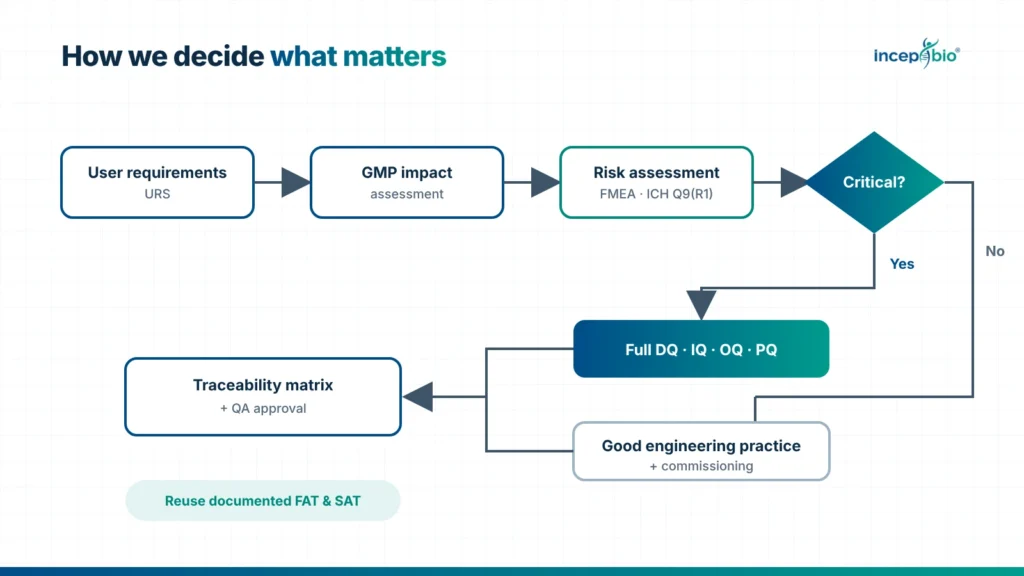
On every project, our CQV engineers follow the same process to decide where testing effort goes:
- User requirements (URS): We start with a clear user requirements specification that separates quality-critical requirements from nice-to-haves.
- GMP impact assessment: Every system is sorted into direct impact, indirect impact or no impact.
- Risk assessment (FMEA): For direct-impact systems, we run an FMEA with your engineering, validation and QA teams to identify the critical aspects.
- Traceability matrix: Every decision is captured in a traceability matrix, so each requirement links to its risk, test and result.
- QA approval: Your QA team approves the rationale before testing starts, as part of our risk-based CQV services.
Risk-Based CQV Example: 3 Testing Levels on a Sterile Project
Here is how risk-based CQV applies to three typical systems on a sterile manufacturing project:
Which testing level do your systems need?
Send us your system list. Our CQV team will map each system to the right level of testing.
Proof That Matters to Auditors
Testing what matters only works if you can show why. Risk-based does not mean less evidence; it means focused evidence that an auditor can follow from start to finish. A complete risk-based CQV package usually includes:
- URS and GMP impact assessment
- Risk assessment (FMEA) with critical aspects, CQAs and CPPs
- Commissioning and qualification plan, showing which FAT and SAT tests are reused
- IQ, OQ and PQ protocols and reports for critical systems
- Traceability matrix, closed deviations and a final summary report
Planning CQV for a new or upgraded facility?
Get a risk-based CQV plan that puts effort where it matters and stays audit-ready.
Our Risk-Based CQV Services in India, Malaysia and Singapore
IncepBio is a CQV company in India with on-site CQV engineers in Bangalore, Hyderabad, Malaysia and Singapore. Our pharmaceutical CQV services use risk-based CQV from design review to handover:
- Risk assessments (FMEA) that decide where testing effort goes
- Commissioning and qualification under one plan, so FAT and SAT results are reused
- One team for facility, utility, equipment, thermal validation and CSV
- Dedicated CQV support through ValBio
Your QA team approves every decision. Request a CQV proposal for your project.
Conclusion
Risk-based CQV isn’t about testing less. It’s about testing what matters. Put full effort into the systems that touch your product and patients, use good engineering practice for the rest, and record every decision. The result is a faster project, a lighter document load and a qualification package that stands up to inspection.
Need risk-based CQV services in India, Malaysia or Singapore?
Explore our pharmaceutical CQV services or talk to our team today.
References
- ICH Q9(R1): Quality Risk Management (2023)
- European Commission, EudraLex Volume 4, Annex 15: Qualification and Validation
- ISPE Baseline Guide Vol. 5: Commissioning and Qualification; ASTM E2500
Frequently Asked Questions
Is risk-based CQV accepted by regulators?
Yes. ICH Q9(R1) and EU GMP Annex 15 both support testing in proportion to risk, as long as the rationale is documented and approved by QA.
Can FAT and SAT results replace IQ and OQ tests?
Some can, if they were planned with QA, properly documented, and the tested functions were not affected by shipping or installation.
Do you provide risk-based CQV services in Bangalore and Hyderabad?
Yes. IncepBio provides CQV services in Bangalore and Hyderabad, with CQV engineers working on site at your facility, and supports pharma and biotech sites across India.
Do you offer CQV services in Malaysia and Singapore?
Yes. We provide risk-based CQV services for pharmaceutical and biotech sites in Malaysia, including Kuala Lumpur, and in Singapore, with on-site support through execution.